Martin Archer Shee
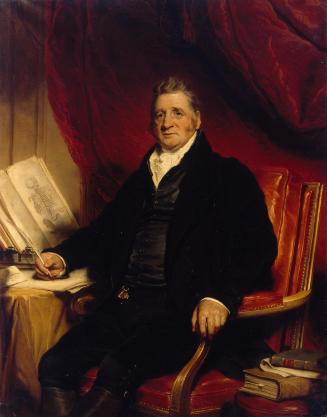
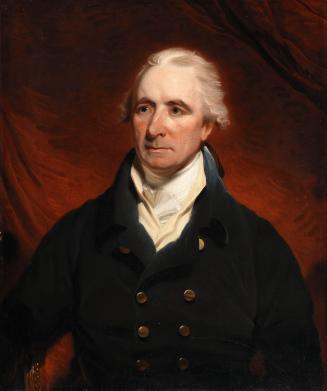
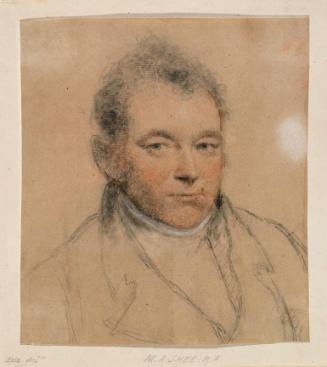
Sir Martin Archer Shee was born in Dublin, 1769. Following his mother's death in the year 1771, Shee and his brother moved to Wicklow. He received a classical education in Dublin from the Dominican order. His artistic training began when he first studied under Francis Robert West at the drawing academy of the Royal Dublin Society. During his time at the drawing academy he was awarded a silver palette and earned most of the premiums availabe to artists at the time. At the age of 15, he was an established portrait painter working in the medium of pastels. In 1789, Shee was accepted for the first time into the Royal Academy exhibition. From 1792 he continued to exhibit at the RA until 1845. In December 1796 Shee married Mary, the eldest daughter of James Power of Youghall, Co. Cork. With the expulsion of the artist Barry from the RA, Shee was elected Royal Academician in 1800. At the expense of Henry Stewart of Trycallen, second son of James Stewart of Killymoon, the artist Martin Cregan (1788-1870) was placed as a pupil in his studio. The turn of the century marked the beginning of Shee depicting an increasing number of aristrocratic sitters. In 1802, Shee visited Paris to study Napoleon. Shee is also noted as an established poet and published works such as the publication "Rhymes on art" and "The Remonstrance of a Painter" (1805). These works may have had affects upon the establishment of the British Institution and Shee exhibited there for many years after 1807. In 1805 Shee is first remembered for having a political role in the Royal Academy. One of the matters he dealt with was the conduct and proceedures practised by the hanging committee of the Academy, which involved the work of Joseph Farrington. In 1830 Shee was elected president of the Royal Academy and was knighted. His popularity among fellow academics, artists and writers was evident in 1845, when Shee offered his resignation and fellow academics re-elected him, along with a gift of £300 per annum from their funds. In 1826 Shee became an honorary member of the Royal Hibernian Academy, having worked and campaigned for its establishment in previous years. Shee's death, 19 August 1850, was the result of a prolonged illness. He was survived by three sons and three daughters.