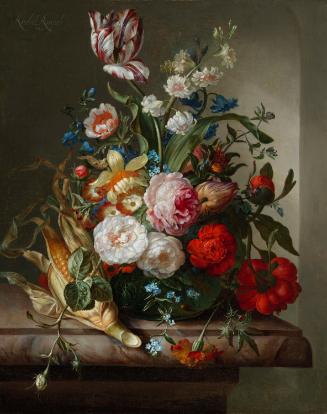
Rachel Ruysch
Still life is one of the archetypal art forms of Dutch Baroque art (sometimes called the ‘Golden Age’), and Rachel Ruysch has long been regarded as one of the best Dutch still life painters of her time. She is also one of the most important women artists in the history of art. Ruysch trained under the prolific naturalist and skilled botanical artist Maria Sibylla Merian (1647-1717), and along with her sister Anna (1666-1754), they were both apprenticed under the still life painter Willem van Aelst (1627-after 1687). The sisters’ interest in flowers must have come from their father, the renowned botanist and anatomist Frederich Ruysch (1631-1731). In 1693 Rachel Ruysch married the portraitist Jurriaen Pool II (1666-1745), and together they had ten children, sadly losing many of them before they reached adulthood. By 1699, she was offered membership to the Confrerie Pictura, the artists’ society in The Hague, as their first female member. Ruysch’s career was prolific for even the most distinguished of artists in the period. She produced works for foreign nobles and aristocrats, namely the Prince of Anhalt-Koethen, the Elector Palatine of Dusseldorf, and Florentine Grand Duke Cosimo III de’ Medici. In her lifetime her paintings were sold for prices as high as 750-1200 guilders; the cost of a comfortable Dutch house. Her artistic output diminished somewhat around 1725-1735, owing to her winning the jackpot in the Dutch lottery, totalling 60,000 guilders (€710,000 today). Subsequently, between 1738-1748/49, she made on average at least one painting a year. At her death, a collection of poems were written in her honour. No other artist of that period had ever received such a tribute.