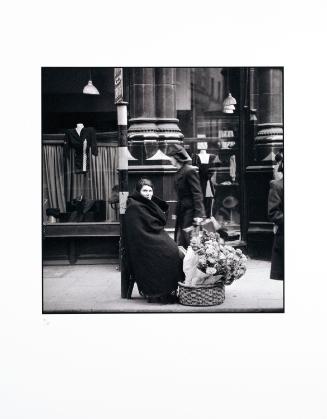
Lee Miller
Born in 1907 in Poughkeepsie, New York, Lee Miller’s first encounter with photography was with her father, Theodore. An amateur photographer, he owned a Kodak Brownie and a stereoscope, had a home darkroom, and taught her the basics of the craft.
In 1926, at age 19, she left home and enrolled in the Art Students League in Manhattan, where she studied life drawing and painting. That winter she met magazine publishing magnate Condé Nast when he saved her from being hit by oncoming traffic. Impressed by her beauty, he took her in to be a model for Vogue. She was on the cover of the American and British editions in March 1927. Miller was photographed by the notable fashion photographers Arnold Genthe, Nickolas Muray, and Edward Steichen.
In 1929, she moved to Paris and sought out the well-known surrealist artist, Man Ray and for three years lived with him as his student, collaborator, muse, and lover. He taught her photography, and in 1929 they developed and worked on solarization, a technique that reversed the negative and positive parts of a photo. Miller also opened her own photography studio while living in Paris.
Man Ray created some of his most-recognized works while he was involved with and collaborating with Miller, including Observatory Time—the Lovers (c.1931), which features Miller’s lips. While Miller was in Paris, she met many artists-Paul Éluard, Pablo Picasso, Max Ernst, Joan Miró-and photographed all of them. She also met Jean Cocteau, a Surrealist artist and rival of Man Ray, who cast her in the leading role in his first film, Le Sang d’un poet (1930-32). Soon after, she and Man Ray split up, and Miller returned to New York City in 1932, where she set up her own studio, which ran for 2 years and was highly successful. It closed when she married Egyptian businessman, Aziz Eloui Bey and went to live with him in Cairo, Egypt. She became fascinated by long range desert travel and photographed desert villages and ruins.
During a visit to Paris in 1937 she met Roland Penrose, the Surrealist artist who was to become her second husband, and travelled with him to Greece and Romania. In 1939 she left Egypt for London shortly before World War II broke out. She moved in with Roland Penrose and defying orders from the US Embassy to return to America she took a job as a freelance photographer on Vogue.
In 1944 she became a correspondent accredited to the US Army, and teamed up with Time Life photographer David E. Scherman. She was one of very few female combat photo-journalists to cover the war in Europe.
After the war she continued to work for Vogue for a further 2 years, covering fashion and celebrities. In 1947 she married Roland Penrose and contributed to his biographies of Picasso, Miro, Man Ray and Tapies. Some of her portraits of famous artists like Picasso are the most powerful portraits of the individuals ever produced, but it is mainly for the witty Surrealist images which permeate all her work that she is best remembered.