Gilles Peress
Gilles Peress was born in 1946 in Neuilly-sur-Seine, France and grew up in Paris with his mother, an orthodox Christian from the Middle East, and his father, who was of Jewish and Georgian descent. Peress studied at the Institute d ’Etudes Politiques in Paris from 1966 to 1968 and then at the University of Vincennes until 1971. Peress began working as a photographer in 1970, embarking on an intimate portrayal of life in the French village, Decazeville, as it emerged from the ashes of a debilitating labour dispute. By 1971, he had established himself as a freelance photographer, publishing work in Du, the London Sunday Times, The New York Times Magazine, Photo, and other periodicals. He was invited to join the international cooperative photography agency, Magnum Photos in 1972.
In 1973, he photographed Turkish immigrant workers in West Germany and documented the European policy to import cheap labour from the third world.
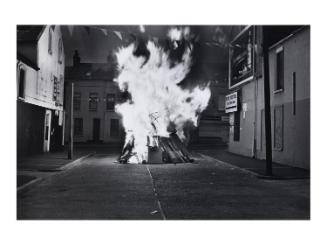
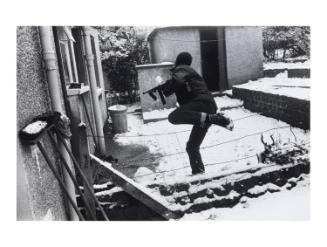
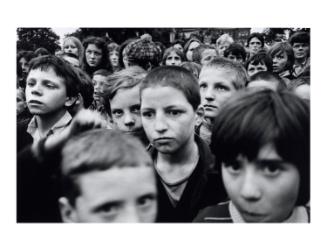
In the early 1970s, Peress travelled to Northern Ireland to begin a project that would last over 20 years about the Irish civil rights struggle. Power in the Blood, a book that synthesizes his years of work in Northern Ireland, is the third part of his ongoing project called “Hate Thy Brother”, a cycle of documentary stories that describe intolerance and the re-emergence of nationalism in the post-war years. Farewell to Bosnia was the first part of this cycle, and The Silence, a book about the genocide in Rwanda, was the second.
Peress's oeuvre demonstrates his unique ability to navigate and communicate the atmosphere and urgency of volatile political environments. While his early work identified him as a "concerned photographer," his more recent work suggests an increasing concern with form and a more obvious sense of subjectivity. In this respect, Peress's photographs echo the photojournalism of Henri Cartier-Bresson, whose conflation of aesthetics and reportage set the precedent for artistic photojournalism earlier in the century.