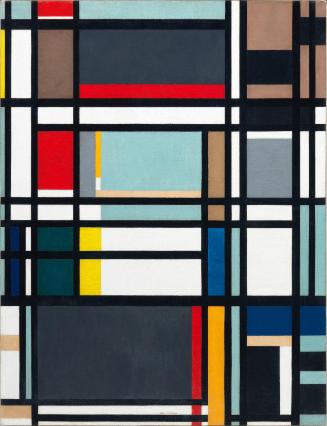
Ilya Bolotowsky
Ilya Bolotowsky was born into a Jewish family in St. Petersburg, Russia. Following the Russian Revolution, the family moved to Baku and Constantinople, before settling in the United States in 1923. Bolotowsky studied in the National Academy of Design between 1924 and 1930 before spending several years working as a textile designer. In 1932 he travelled around Europe and spent time in Paris. Back in New York he worked on projects for the Public Works of Art Project and the Works Progress Administration, including designing an abstract mural for the Williamsburg Housing Project. In the 1930s he was a member of “The Ten” an independent group of artists that included Adolph Gottlieb and Mark Rothko. Bolotowsky served in the Army Air Corps during the Second World War. Subsequently he taught at Black Mountain College, North Carolina where he replaced Josef Albers. He went on to hold numerous teaching posts including those at University of Wyoming, Brooklyn College, and University of Wisconsin.
By the 1940s Bolotowsky had turned completely towards geometric abstraction. He came to know and was profoundly influenced by Piet Mondrian who had fled to New York from Europe in 1940. Throughout his career, Bolotowsky maintained a singular vision. Although he was prolific and experimental, he maintained a resolved sense of colour, harmony, and movement. As well as producing paintings, textiles, and mural designs, Bolotowsky wrote articles, stories, plays, and made films. His work is held by most major USA collections, including MoMA, Metropolitan Museum of Art, Smithsonian, Guggenheim, Art Institute of Chicago, and Whitney Museum of Modern Art.