
Jacob Jacobsz. de Wet II

Close
Refine Results
Artist
Classification
Artist Info
Jacob Jacobsz. de Wet II1640-1697

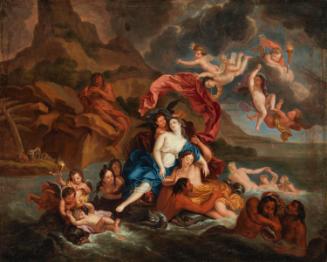
The artist remains shadowy and little documented. He was son of the better-known Jacob de Wet (c.1610-after 1675), who may have been in Rembrandt’s studio and later trained Paulus Potter. Sir William Bruce, King’s Surveyor and Master of the King’s Works in Scotland, brought him to Edinburgh to decorate his new state apartments (1671-74) at the Palace of Holyroodhouse. He had been in Holland until the Restoration of Charles II (mostly as a merchant in Rotterdam), so presumably kept his Dutch contacts. De Wet’s ceiling of the King’s Bedchamber and Hercules Strangling Serpents overmantel show his ability at royal flattery. De Wet also painted The Apotheosis of Hercules, The Finding of Moses, a bathing scene and Galatea and Polyphemus inset in the panelling. He then worked for the Scottish nobility, significantly the Earl of Strathmore, decorating the chapel of Glamis Castle with scenes from the New Testament. From 1684, he carried out his largest commission: all the Kings of Scotland, in full-length or bust, for Holyrood Palace. To carry out this assertion of the Stuart dynasty, he was sent George Jamesone’s 1633 set of kings to copy, though used other sources too, for a vapid series of ‘fake’ portraits. 97 of the 111 survive. De Wet returned, at unknown date, to Holland and died in Amsterdam. He is not to be confused with the decorative painter Jacob de Wit (1695-1749).
Read MoreRead Less
Sort:
/ 1
Filters
1 to 1 of 1
Galatea and Polyphemus
Jacob Jacobsz. de Wet II
c.1673-75
/ 1

This website uses cookies

We use optional cookies to enhance your user experience and to analyse our traffic. We also share information about your use of our site with our analytics partners who may combine it with other information that you’ve provided to them or that they’ve collected from your use of their services.

Details

About Cookies

Cookies are small text files that can be used by websites to make a user's experience more efficient. The law states that we can store cookies on your device if they are strictly necessary for the operation of this site. For all other types of cookies we need your permission. This site uses different types of cookies. Some cookies are placed by third party services that appear on our pages. You can at any time change or withdraw your consent from the Cookie Declaration on our website. Learn more about who we are, how you can contact us and how we process personal data in our Privacy Policy. Please state your consent ID and date when you contact us regarding your consent.

Necessary Cookies

Necessary cookies help make a website usable by enabling basic functions like page navigation and access to secure areas of the website. The website cannot function properly without these cookies.

Name Provider Purpose Expiry Type
JSESSIONID eMuseum User Session Session HTTP

Statistics Cookies

Statistic cookies help website owners to understand how visitors interact with websites by collecting and reporting information anonymously.

Name Provider Purpose Expiry Type
_ga Google Tag Manager Registers a unique ID that is used to generate statistical data on how the visitor uses the website. 2 years JavaScript
_gid Google Tag Manager Registers a unique ID that is used to generate statistical data on how the visitor uses the website. 1 day JavaScript
Allow only necessary Allow all