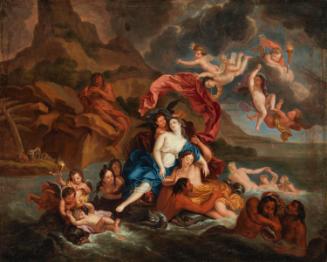
Jacob Jacobsz. de Wet II
The artist remains shadowy and little documented. He was son of the better-known Jacob de Wet (c.1610-after 1675), who may have been in Rembrandt’s studio and later trained Paulus Potter. Sir William Bruce, King’s Surveyor and Master of the King’s Works in Scotland, brought him to Edinburgh to decorate his new state apartments (1671-74) at the Palace of Holyroodhouse. He had been in Holland until the Restoration of Charles II (mostly as a merchant in Rotterdam), so presumably kept his Dutch contacts. De Wet’s ceiling of the King’s Bedchamber and Hercules Strangling Serpents overmantel show his ability at royal flattery. De Wet also painted The Apotheosis of Hercules, The Finding of Moses, a bathing scene and Galatea and Polyphemus inset in the panelling. He then worked for the Scottish nobility, significantly the Earl of Strathmore, decorating the chapel of Glamis Castle with scenes from the New Testament. From 1684, he carried out his largest commission: all the Kings of Scotland, in full-length or bust, for Holyrood Palace. To carry out this assertion of the Stuart dynasty, he was sent George Jamesone’s 1633 set of kings to copy, though used other sources too, for a vapid series of ‘fake’ portraits. 97 of the 111 survive. De Wet returned, at unknown date, to Holland and died in Amsterdam. He is not to be confused with the decorative painter Jacob de Wit (1695-1749).