Basil Blackshaw
Basil Blackshaw was born in 1932 in Glengormely, County Antrim, and raised in Boardmills, County Down. Blackshaw grew up in the countryside surrounded by horses and hounds. His father owned a livery yard, and as a child Blackshaw learned to ride horses and helped his father train horses and greyhounds. Blackshaw enrolled in Belfast College of Art at the age of sixteen, where he attended from 1949 to 1951. While there, he was awarded a Council of Encouragement of Music and Arts (CEMA) scholarship, which enabled him to study in Paris. His early influences included Oskar Kokoschka (1886-1980), Paul Cézanne (1839-1906), and Alberto Giacometti (1901-1966). Blackshaw’s work was acquired by the Ulster Museum while he was in his early twenties. He exhibited regularly throughout his life in solo and group shows. A major retrospective of his work was organised by the Arts Council of Northern Ireland in 1995, which travelled to Belfast, Dublin, Cork, and the United States. In 2001, he won the Glen Dimplex Award for Sustained Contribution to the Visual Arts in Ireland. He was elected an associate of the Royal Ulster Academy of the Arts in 1977, and an academician in 1981. Blackshaw was a member of Aosdána. His work is held in public collections in Ireland including the National Gallery of Ireland; the Ulster Museum; the Irish Museum of Modern Art (IMMA); the Arts Council of Ireland; and the National Self Portrait Collection, University of Limerick.
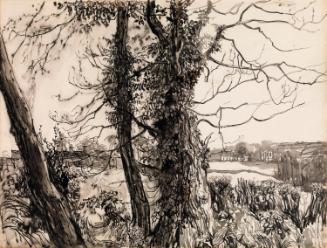
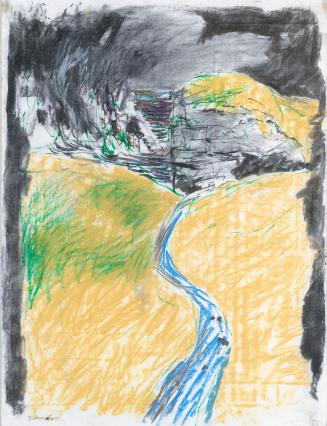
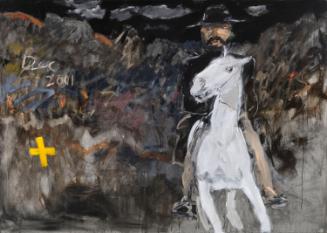
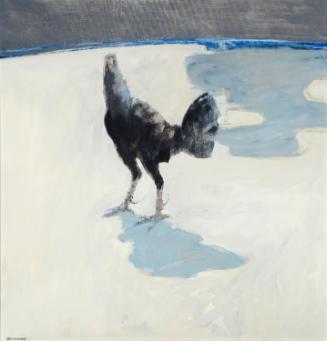
Blackshaw’s principal subjects are animals, particularly horses, dogs, and cockerels. His upbringing with animals and his naturally affinity for them is attested to in his sympathetic and characterful renderings of them in his artworks. Blackshaw also painted portraits of eminent figures in the arts, culture, and politics including Brian Friel, Clint Eastwood, John Hume, and Michael Longley. Blackshaw’s brushwork is spontaneous and sketch-like. His paintings have an expressive quality, capturing the liveliness and movement of his subjects. Colour palettes are minimal with dramatic splashes of red or yellow. Some works include graffiti-like elements with scrawled text and flat mural-like compositions. His work was more traditional at first, though developed to become freer over time.