Frank O'Meara
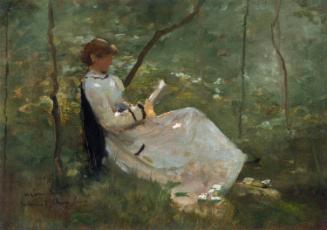
The son of a doctor, Frank O’Meara travelled to Paris in 1872 to enrol in the studio of Carolus-Duran. From there, he travelled the relatively short distance south of the capital to the Forest of Fontainebleau, where the picturesque village and artists’ colony of Grez-sur-Loing became his home for thirteen years. Grez was particularly popular among Anglophone and Scandinavian visitors, who included John Lavery, and the writer Robert Louis Stephenson, both of whom O’Meara befriended. It has been suggested that the frequently melancholic character of O’Meara’s paintings was attributable to the loss in childhood of two sisters and the death of his mother.
Though O’Meara was not as prolific as his peers in Grez, he was greatly admired, and was a central figure in the artistic community there. Clearly identifiable by his distinctive attire, he appears in group photographs taken in Grez, and features at the centre of John Lavery’s exquisite painting On the Bridge at Grez (NGI). Having contracted malaria, he returned to Ireland in 1888, and died in his native Carlow. It is understood that O’Meara, inspired by his experience in Grez in particular, had harboured ambitions to establish a similar artists’ colony in Ireland, as returning artists had done elsewhere in Europe and the United States. Sadly, his death at the age of thirty-five prevented him from realising this ambition.
Sir Hugh Lane included some seven works by O’Meara in his exhibition of Irish Art in the Guildhall in 1904. Six works by O’Meara, including the outstanding Towards Night and Winter and The Widow, and a portrait of him by John Singer Sargent, are now in the collection of the Hugh Lane Gallery. Two further works are in the collection of the Ulster Museum.