
E. Grace Mitchell Henry
, Scottish, 1868-1953
Title
Still Life with Marble TorsoDate1920s
MediumOil on canvas
Dimensions
59.7 x 49.5 cm
Signedlower right: G Henry
Credit LinePurchased, 1999
Object numberNGI.4664
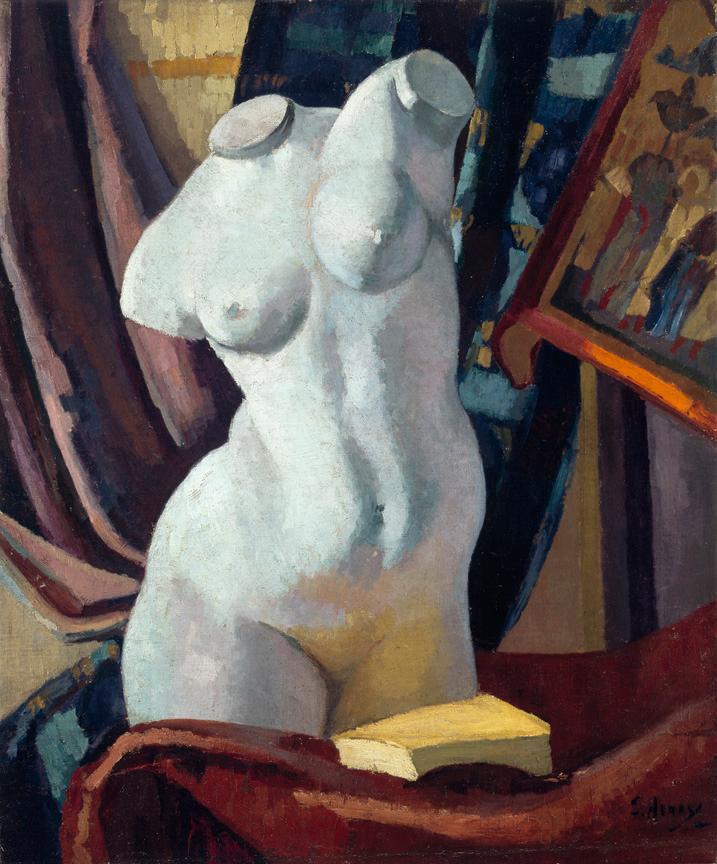
DescriptionAlthough Grace Henry is best remembered for her paintings of the west of Ireland, she also produced many still-life and flowers subjects. Still Life with Torso offers an interesting variation on the still-life theme. The collection of objects placed close to each other include a truncated marble torso, a book, a framed picture and some heavy draperies of varying hues and patterns. The whole ensemble is sharply lit from the left, resulting in interesting light and shade effects on the surface of the marble. The bright white of the stone is softened by a series of subtle shadows emanating from the blue and deep purple of the draperies and the yellow cover of the book. Light catches also on the the lower edge of the picture frame, which is painted in a striking red. Aside from her interest in the reflective qualities of light, the artist is clearly fascinated by unconventional viewpoints. There is no single perspective in the composition. Instead, the objects of still life are seen from a variety of perspectives. The torso is viewed from below, while the framed picture hanging suspended in mid-air is viewed at a slightly different angle. The draperies behind and on the table, falling in a haphazard way, prevent any sense of the composition being grounded in a definite horizon line.
Grace Henry travelled and studied art in Belgium and France. In 1900 she was in Paris where she met her future husband, the painter Paul Henry. Her interest in modern art is evident in this work with its unusual colouring and viewpoints.
(National Gallery of Ireland: Essential Guide, 2008)
ProvenancePurchased, Christie's, London, 20 May 1999, Irish Sale Label TextGrace Henry’s inclination to experiment with different subjects and techniques in her work is attributable in large part to her experience studying and travelling in Belgium, France and Italy. Though best-known for west of Ireland subjects that complement those of Paul Henry, her husband of twenty-seven years, she also produced paintings that suggest the influence of such figures as Van Gogh, Whistler and Cézanne. In this instance, she applies a vibrant, almost Fauvist palette to a conventional, academic subject.