
Jack B. Yeats
, Irish, 1871-1957
Title
GriefDate1951
MediumOil on canvas
Dimensions
102 x 153 cm
Signedlower left: Jack B. Yeats
Credit LinePurchased, 1965 (Shaw Fund)
Object numberNGI.1769
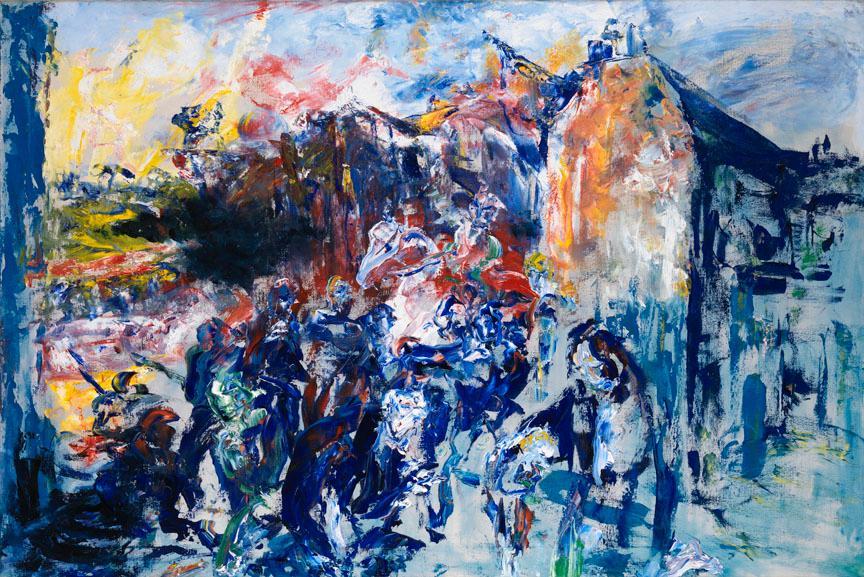
DescriptionGrief, painted when Yeats was exploring particular human emotion in his work, is one of the artist's largest and most-celebrated paintings. The picture, which may have been derived from an original sketch entitled 'Let there be no more war', can be read then as an anti-war statement, akin to Picasso's Guernica. In the picture, rows of soldiers with rifles and bayonets surround a rider on horseback who raises one arm in the air as if to lead a charge. In the foreground, a woman dressed in blue comforts a blond baby. To the left of that pair, an old man, bent double, reaches out his hands in despair. Yeats has applied paint thickly but sparingly on the canvas, and has employed vivid colour to great emotional effect. While the indigo blue suggests sadness, the yellows and reds point to more heightened emotions.ProvenanceThe Artist's executors; Private Collection; purchased, The Waddington Galleries, London, April 1965 Exhibition HistoryJack B. Yeats: Paintings, Victor Waddington Galleries, Dublin, October 1951
Irish Exhibition of Living Art, Victor Waddington Galleries, Dublin, Februari 1955
Society of Scottish Artists, Mound Galleries, Edinburgh, 1957
Jack B. Yeats: Paintings, Felix Landau Gallery, Los Angeles, 23 April - 12 May 1962
Jack B. Yeats: A Centenary Exhibition, National Gallery of Ireland, Dublin, September - December 1971; Cultural Centre, New York, April - June 1972
Rosc Chorcaí '80: Irish Art, 1943-1973, Crawford Municipal Gallery, Cork, 24 August - 7 November 1980; Ulster Museum, Belfast, 1980
Jack B. Yeats in the National Gallery of Ireland, National Gallery of Ireland, Dublin, 26 March - 20 April 1986
Jack B. Yeats: The Outsider, The Model, Sligo, 5 February - 12 June 2011
Lines of Vision. Irish Writers at the National Gallery of Ireland, 8 October 2014 —12 April 2015
Label TextGrief is perhaps Yeats’s most powerful expression of his abhorrence of war. It appears to originate from a sketch entitled 'Let there be no more war', which the artist made in his last workbook. At the centre of the painting, an apocalyptic figure, on horseback amidst and angry mob, gestures aggressively. In the foreground, an elderly man looks at the blood that drips onto his hands, while a mother places her arm protectively around a small child. Yeats describes a scene of violence and chaos with characteristic economy, vigour and emotional intensity.