Mainie Jellett
, Irish, 1897-1944
Title
DecorationDate1923
MediumTempera on wood panel
Dimensions
89 x 53 cm
Signedlower right: M. Jellett '29
Credit LineBequeathed, Evie Hone, 1955
Object numberNGI.1326
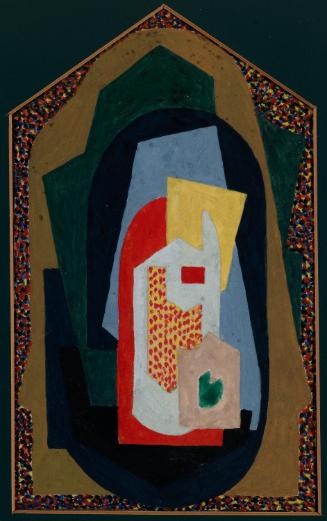
DescriptionJellett trained under William Orpen in Dublin and at the Westminster Art School in London before moving on to Paris in 1920 with Evie Hone. There they studied in turn under André Lhote, an advocate of Cézanne’s analytical approach to painting, and Albert Gleizes, an established Cubist artist. These French painters’ non-representational, highly geometrical paintings proved a strong influence on both Jellett and Hone. Inspired by her experience in France, Jellett began to analyse rhythm, colour and form in her own work, while also drawing on long-standing pictorial traditions. When shown with a similarly abstract painting at the Society of Dublin Painters group show in 1923, Decoration caused a furore. The reviewer from The Irish Times wrote of Jellett’s work in the exhibition:‘they are all squares, cubes, odd shapes and clashing colours. They may, to the man who understands the most up-to-date modern art, mean something; but to me they presented an insoluble puzzle.’ A more strident journalist referred to the ‘sub-human art of Miss Jellett’. The artist drew similar criticism from Irish painters suspicious of Modernism. Through perseverance and a return to more figurative motifs, however, she changed the view of many of her critics.
Though Decoration is essentially abstract and bears a deliberately generic title, its pentagonal format, colour range and media strongly recall religious icons depicting the Madonna and Child.
March 2016
ProvenanceBequeathed, Evie Hone, 1955 Exhibition HistoryGroup show, Dublin Painters Gallery, Dublin, October 1923
Mainie Jellett and Evie Hone, joint exhibition, Dublin Painters Gallery, Dublin, 1924
Mainie Jellett, 1897-1944, Irish Museum of Modern Art, Dublin, 7 December 1991 - 22 March 1992
Analysing Cubism, Irish Museum of Modern Art, 19 February - 19 May 2013; Crawford Art Gallery, Cork, 20 June - 1 September 2013; F.E. McWilliam Gallery and Studio, Banbridge, 13 September - 30 November 2013
Label TextJellett trained in Dublin and London before moving to Paris in 1920. There, with Evie Hone, she studied under André Lhote, an advocate of Cézanne’s analytical approach to painting, and Albert Gleizes, an established Cubist artist. Inspired by their work, she began to analyse rhythm, colour and form in her own work, while also drawing on longer-standing pictorial traditions. Though essentially abstract, Decoration’s format, colour range and media strongly recall religious icons depicting the Madonna and Child. When shown with a similarly abstract painting at the Society of Dublin Painters group show in 1923, Decoration caused a furore.
Finished work:/Preparatory work: