
Jack B. Yeats
, Irish, 1871-1957
Title
The Singing HorsemanDate1949
MediumOil on canvas
Dimensions
61.4 x 92 cm
Signedlower right: JACK B YEATS
Credit LineBequeathed, Máire MacNeill Sweeney, 1987
Object numberNGI.4524
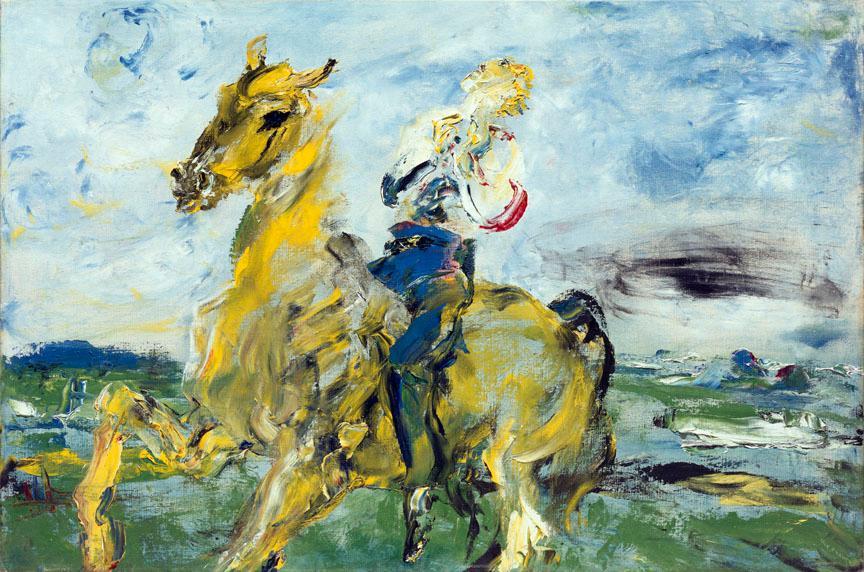
DescriptionYeats painted prolifically in the last two decades of his life, seeking out new subjects but also revisiting earlier compositions to create highly evocative works. His paintings became increasingly visionary and ethereal as he approached old age. He remained sensitive to the hardships, suffering and loneliness endured by many people, and often addressed such subjects in his painting, but also sought to communicate through his work positive heightened emotion, and revelled in the transformative and uplifting power of music and other forms of expression. In this painting, one of Yeats’s most jubilant, a young man on a large, restless horse, clasps his hands together, casts his head back and sings aloud to the heavens. The artist’s love of horses is evident from his early drawings and watercolours to his final paintings. In many late works, among them The Singing Horseman, Yeats used the motif of the horse to augment the mood of his paintings. In this instance, the unbridled steed enhances the notion of abandonment to music. Yeats’s discerning employment of vivid colour and dynamic brushwork imbues both horse and rider with energy and animates the landscape. In a letter of 1952, the artist remarked,‘I got a thrill out of man and horse when I painted them’.
March 2016
ProvenancePurchased from the Artist, J. L. Sweeney, USA, August 1950; bequeathed, Máire MacNeill Sweeney, in his memory, 1987 Exhibition HistoryRoyal Hibernian Academy, Dublin, 1950
A First Retrospective American Exhibition, Institute of Contemporary Art, Boston, March 1951; Phillips Gallery, Washington; De Young Memorial Museum, San Francisco; Springs Fine Arts Centre, Colorado; Toronto Art Gallery, Toronto; Detroit Institute of Arts, Detroit; New York National Academy, New York 1951-1952
Loan Exhibition, Hayden Gallery, Institute of Technology, Massachusetts, 11 January - 17 February 1965
Jack B. Yeats: A Centenary Exhibition, National Gallery of Ireland, Dublin, September - December 1971; Cultural Centre, New York, April - June 1972
Fiftieth Anniversary of the Treaty of Rome, Quirinale Palace, Rome, 25 March 2007 - 25 May 2007
The Music has Come, The Model, Sligo, 31 May - 28 September 2014
Lines of Vision. Irish Writers at the National Gallery of Ireland, 8 October 2014 —12 April 2015
Label TextYeats painted prolifically in the last two decades of his life and his paintings became increasingly visionary and ethereal. He remained sensitive to the hardships, suffering and loneliness endured by many people, and often addressed such subjects in his painting. However he also sought to communicate through his work positive heightened emotion, and revelled in the transformative and uplifting power of music and other forms of expression. In this, one of Yeats’s most jubilant paintings, a young man on a large, restless horse, clasps his hands together, casts his head back and sings aloud to the heavens.