
Stanley Royle
, British, 1888-1961
Title
The Goose GirlDatec.1921
MediumOil on canvas
Dimensions
72 x 91 cm
Credit LinePurchased, 1970
Object numberNGI.4009
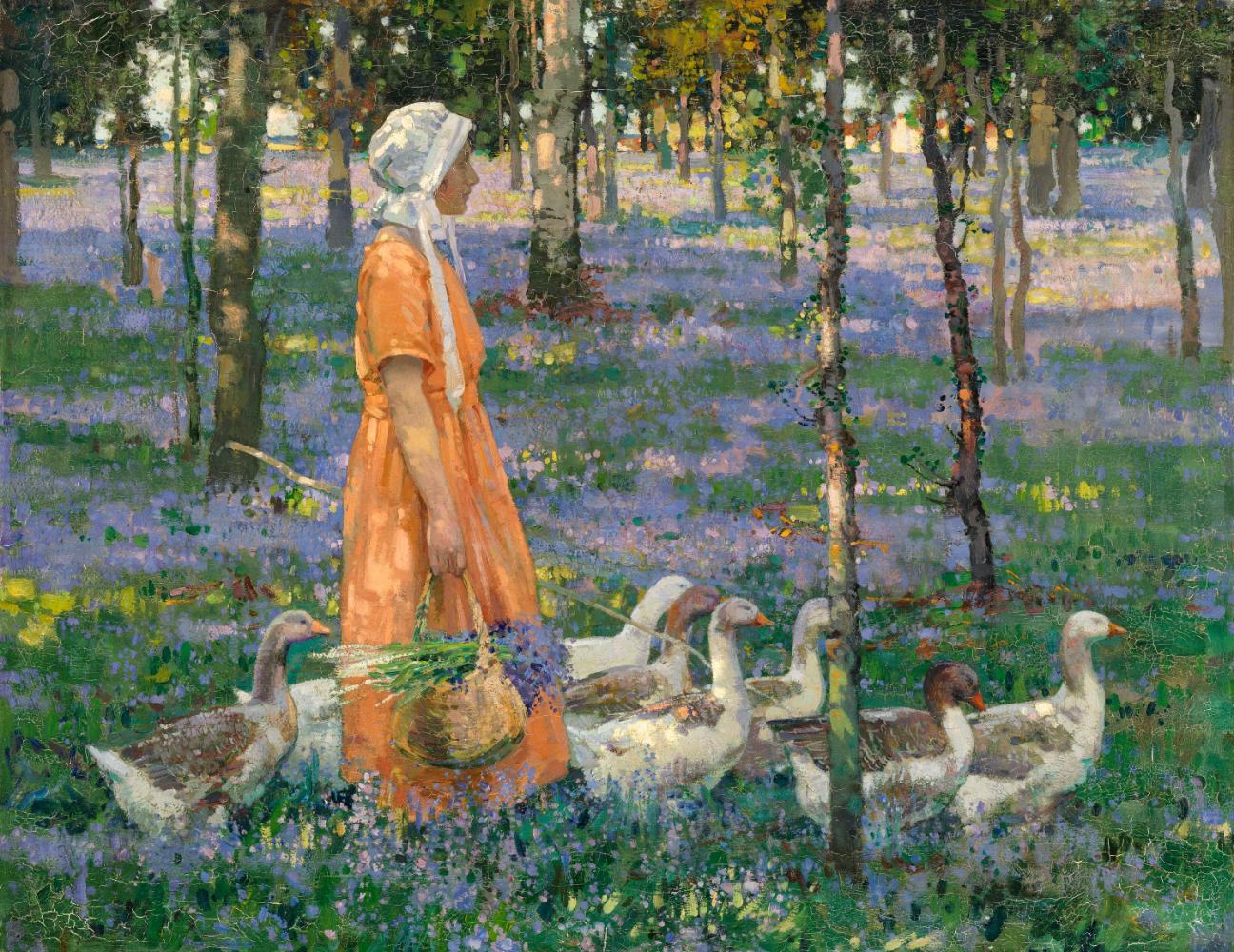
DescriptionA girl moves her geese through a bluebell wood in spring. This attractive image belongs to a series of pictures with woodland settings painted by Royle between 1913 and 1923, around his native Sheffield. The location survives today, despite the city’s growth. The girl is placed within a frieze-like composition, and her lack of expression contributes to the sense of time standing still. The colours are particularly attractive: the green and purple in the wood are balanced against her orange dress, on which sunlight is reflected. This subject and related rural scenes had been popular in England since the time of the nineteenth-century plein-air artists, with the goose girl a theme in Scottish, English and Irish painting. Here the palette and presentation show the influence of Impressionism. The heavy impasto and Royle’s habit of rolling canvases may have contributed to the marked cracking of the paint. The painter’s wife, Lily, the daughter of a sweetshop owner, served as model for the girl here and in other genre paintings of the period. Royle subsequently moved to Canada, where he developed a more abstract landscape approach and had some influence on the next generation of artists.
March 2016
ProvenancePurchased, Private Collection, 1970 Exhibition HistoryR.G.I., Glasgow, 1924
Liverpool, 1925
Post Impressionism, Royal Academy of Arts, London, 17 November 1979 - 16 March 1980
The Peasant in French 19th Century Art, Douglas Hyde Gallery, Dublin, 1980
The Irish Impressionists: Irish Artists in France and Belgium 1850-1914, The National Gallery of Ireland, Dublin, 9 October - 18 November 1984; The Ulster Museum, Belfast, 1 February - 10 March 1985
Lines of Vision. Irish Writers at the National Gallery of Ireland, 8 October 2014 —12 April 2015
Label TextRoyle was an English artist who painted rural scenes in a Post-Impressionist style. Here he depicts a girl guiding geese through a dense carpet of bluebells. The woodland setting is thought to be Whiteley Woods, which were close to the artist’s Sheffield home. Royle has applied paint in distinct touches to convey a sense of dappled light filtering through the trees. His use of complementary colours such as orange and blue is characteristic of Post-Impressionism.