Frederic William Burton
, Irish, 1816-1900
Title
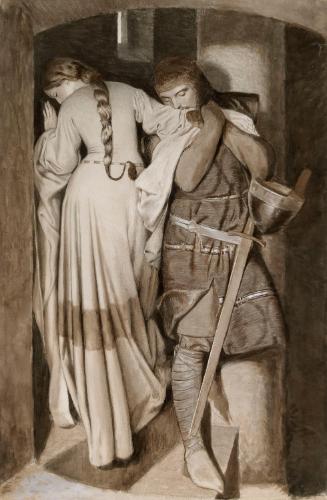
Hellelil and Hildebrand, the Meeting on the Turret StairsDate1864
MediumWatercolour and gouache on paper
Dimensions
95.5 x 60.8 cm
Signedlower left: FWB 1864
Credit LineBequeathed, Margaret McNair Stokes, 1900
Object numberNGI.2358
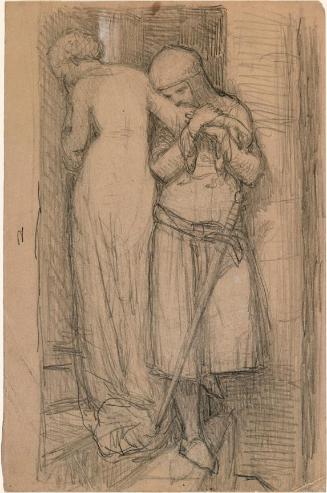
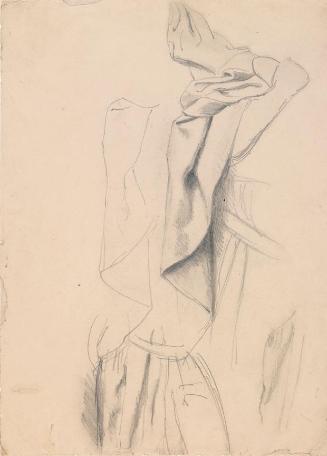
DescriptionThis watercolour was inspired by a medieval Danish ballad, translated by the artist’s friend Whitley Stokes and published in Fraser’s Magazine in 1855. In 1900 the work was bequeathed to the Gallery by Stokes’s sister, the archaeologist and art historian Margaret Stokes. It tells the story of Hellelil, who falls in love with one of her personal guards, Hildebrand, Prince of Engelland. Her disapproving father orders his sons to kill the gallant prince but Hildebrand slays Hellelil‘s brothers, sparing the youngest at her request. Sadly, however, Hildebrand dies of his wounds. Instead of illustrating a violent episode from this tragic story, Burton has chosen to depict the ill-fated lovers in a tender, poignant embrace. The novelist George Eliot praised the picture’s romanticised vision of a chivalric past:‘The subject might have been made the most vulgar thing in the world – the artist has raised it to the highest pitch of refined emotion’. The rich colour and romantic treatment of the subject matter echoes the work of the Pre-Raphaelites, whom Burton greatly admired. He worked slowly and precisely on his watercolours, often producing numerous preparatory studies, and used very fine brushstrokes, reminiscent of a miniaturist’s technique. Burton stopped painting when he was appointed Director of the National Gallery, London in 1874, a post he held for 20 years.
March 2016
ProvenanceSold by the Artist to dealer Edward Fox Withem, 1864; J.W. Knight, from the Dublin exhibition 1865; Agnew's, 1866; J.W. Knowles, Manchester; Christie's, 7 May 1877, John Knowles sale, lot 67; J. Grant Morris; Christie's, 23-25 April 1898, J. Grant Morris sale, lot 7; Agnew's; Miss Margaret Stokes, 1898; bequeathed, Miss Margaret Stokes, 1900 Exhibition HistoryAnnual Exhibition, 'Old' Society of Painters in Watercolours, Dublin, 1864
Dublin International Exhibition of Arts and Manufactures, Exhibition Hall, Earlsfort Terrace, Dublin, 1865
Loan Collection of Works by Sir Frederic William Burton, R.H.A., National Gallery of Ireland, Dublin, 1900
Whitechapel Exhibition of Irish Art, Guildhall, London, 1913
Irish Art in the 19th Century, Crawford Municipal School of Art, 31 October - 29 December 1971
Aspects of Irish Art, Columbus Gallery of Fine Arts, Columbus; Toledo Museum of Arts, Toledo; St Louis Art Museum, St. Louis, 1974
Irish Watercolours 1675-1925 from the National Gallery of Ireland, Museum of Fine Arts, Dallas, 1976
Irish Watercolours and Drawings, McMullen Museum of Art Boston College, Boston, 4 October 1993 – 5 December 1993
Label TextThe subject is taken from a medieval Danish ballad translated by Burton’s friend Whitley Stokes in 1855, which tells the story of Hellelil, who fell in love with her personal guard Hildebrand, Prince of Engelland. Her father disapproved of the relationship and ordered her seven brothers to kill the young prince. Burton chose to imagine a romantic moment from the story before the terrible end: the final meeting of the two lovers. Although he never painted in oils, the intensity of hue is similar to that of an oil painting. The precise layering of watercolour reflects his early training as a miniaturist.