
John Kindness
, Irish, b.1951
Title
Scylla & CharybdisDate2022
MediumGouache and varnish on paper
Dimensions
154 × 106 cm
Signedon verso, lower right: John Kindness 2022
Credit LinePresented, 2025
Object numberNGI.2025.12
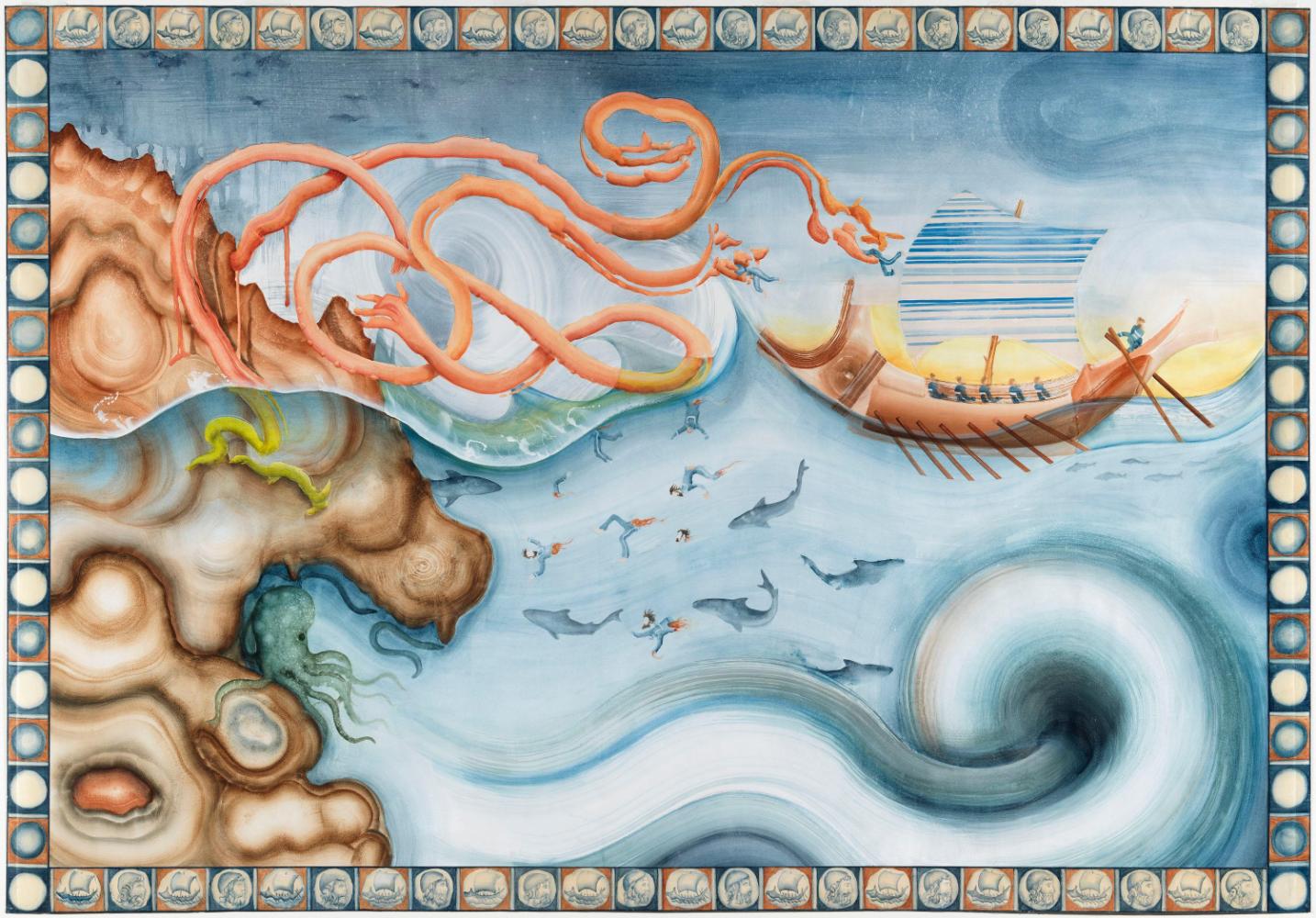
DescriptionKindness’ long-held fascination with wryly appropriating Greek mythology to interpret contemporary life forms the basis of this work. Here, he explores an episode in the story of Scylla and Charybdis who feature in Homer’s Odyssey, a major source of inspiration for the artist. According to Greek mythology, Scylla and Charybdis were monsters that inhabited opposite sides of a channel of water, sometimes imagined as the Strait of Messina separating Italy from Sicily. Scylla, a former lover of Poseidon, had been transformed into a hideous beast by the poisoned bath salts of Poseidon’s angry wife Amphitrite. Charybdis was a massive underwater beast, later rationalised as a whirlpool that would drink in ocean water three times a day and spew it out again. Sailors had to choose how to navigate the hazard. If you sailed too close to Scylla, she would snatch six people from your ship, but the rest would survive. If you went too close to Charybdis, you risked your whole ship being sucked down and destroyed. “Caught between Scylla and Charybdis” was the ancient equivalent to our “stuck between a rock and a hard place.”
In this picture, Kindness depicts the point in The Odyssey when Odysseus and his men must navigate the straits between Scylla and Charybdis. Scylla, the six-headed monster is portrayed by Kindness as a snake-like figure rising above the water, snatching sailors from the boat that is just about staying afloat on the choppy waters caused by Charybdis. At least six bodies have been submerged, caught in a whirlpool among sharks and an octopus in line with the myth.
Inscriptionon verso, lower right: Scylla & Charybdis/Gouache and varnish on paper
ProvenanceThe artist; Purchased by the previous owner, 2024; Presented, 2025Exhibition HistoryThe Odyssey, Summerhall Arts, Edinburgh, 25 November 2022 - 30 June 2023; The Royal Hibernian Academy of Arts, Dublin, 07 December 2023 - 18 February 2024