
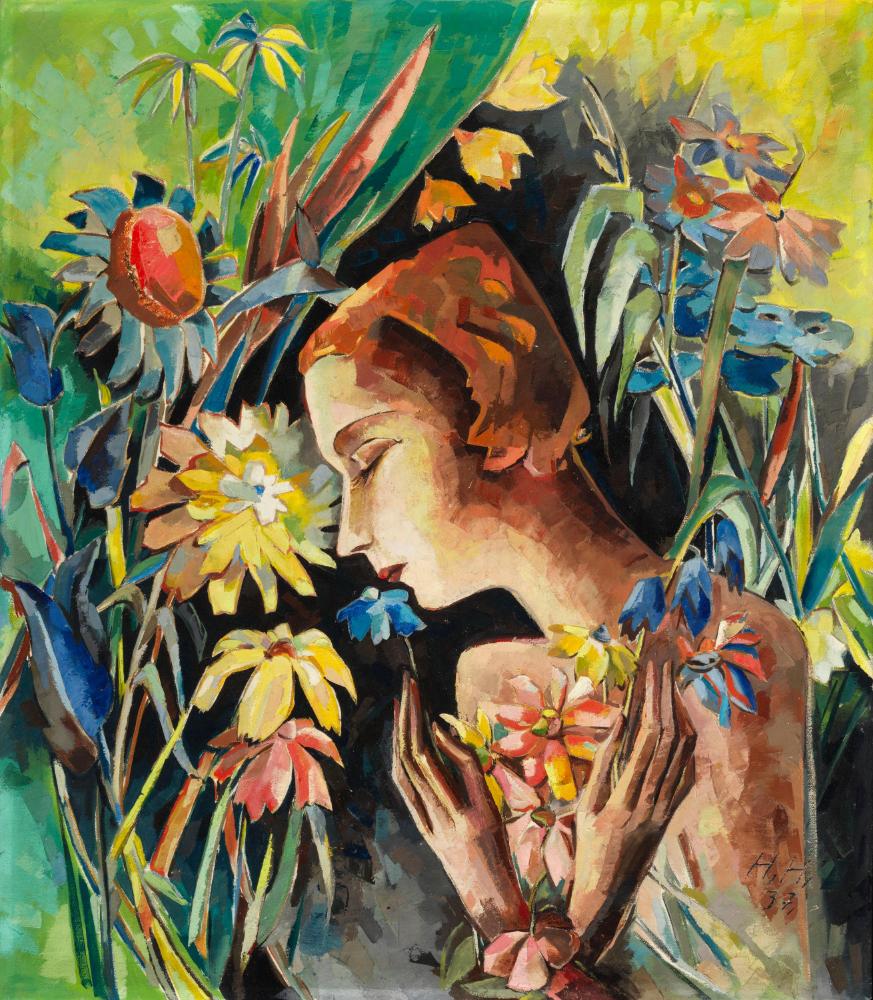
Hannah Höch
, German, 1889-1978
Title
DuftDate1937
MediumOil on canvas
SignedLower right: H.H.37
Credit LinePurchased, 2023
Object numberNGI.2023.21
DescriptionHannah Höch was an avant-garde photomontage artist, collage artist, and painter. She is renowned for her political photomontages and was an influential pioneer in the art form. Höch’s initial training was in stained glass and graphic art. She became involved with the Dada group in 1917 and was one of its few women members. In 1920, she exhibited at the First International Dada Fair in Berlin. Höch criticised the politics of the Weimar Republic in her early work. She contested the idea of the “New Woman” and explored ideas about beauty and gender conformity.
Between 1926 and 1936, Höch lived with her partner the Dutch author, poet, and linguist Mathilda (Til) Brugman in The Hague and Berlin. They were involved with avant-garde circles such as De Stijl. Brugman published Scheingehacktes: Grotesken mit Zeichnungen von Hannah Höch in 1935.
The rise of the Nazi Party curtailed Höch’s professional and creative ambitions. It classified her as a “Degenerate” artist and banned her from exhibiting in public. In 1939, she moved to Heiligensee on the outskirts of Berlin where she lived unobtrusively, cultivated a garden, and made art.
After the war, Höch continued to work and exhibit. In 1945, she wrote in her diary - “Twelve years of misery – forced on us by a mad, inhuman, yes, bestial ‘clique’, using every kind of common force, every mental device, every resource of a barbarism that baulks at no crime – are over. In my soul there is a calmness, such as I haven’t felt for many years.”
Duft (Fragrance) is a self-portrait. Höch depicts herself inhaling the smell of the flowers that surround her. The setting is an imagined one, like a garden at night. The colouring is vibrant and expressive, which heightens the dreamlike mood of the scene. Certain compositional details such as the flower petals are outlined in contrasting colours and appear layered. This reflects the artist’s skill in photomontage, graphics, and stained glass.
From 1916 to 1926, Höch worked for the publisher Ullstein Verlag. Based in the handicrafts department, she made designs for Die Dame (The Lady) and Die Praktische Berlinerin (The Practical Berlin Woman). The stylised figure and flowers in Duft are certainly informed by contemporary fashion journals, photography, and advertising.
At first glance, Duft may appear decorative but there is an emotional gravity behind the joyful surface. The personal was always political for Höch. Speaking of how oppressive life was in 1930s Germany, she said - ‘I often wonder how I managed to survive that dreadful reign of terror.’
When Höch made this painting, she faced serious challenges in her personal and professional life. In 1937, she detailed these issues in her diaries. She suffered health problems associated with Graves’ disease. She was also involved in a volatile relationship with a businessman, Kurt Matthies. They married in 1938 but separated soon after.
Höch was always interested in plants and nature. Botanical forms feature frequently in the photomontages, drawings, and paintings she made throughout her long career. For Höch, plants represented fragility, endurance, renewal and, most especially in the 1930s, escapism.
InscriptionOn verso: Hannah Höch 37. Berlin
ProvenanceThe artist's estate and then by descent; acquired from the above by the previous owner; Purchased 2023Exhibition HistoryHannah Höch, Museen der Stadt Gotha, Gotha, August - November 1993, no.114 p.190 (illustrated p.83)
Hannah Höch, Flora Vitalis, Kunsthaus Apolda Avantgarde, Apolda, July - September 2017, no. 60, pp. 80 & 143 (illustrated p.81)