
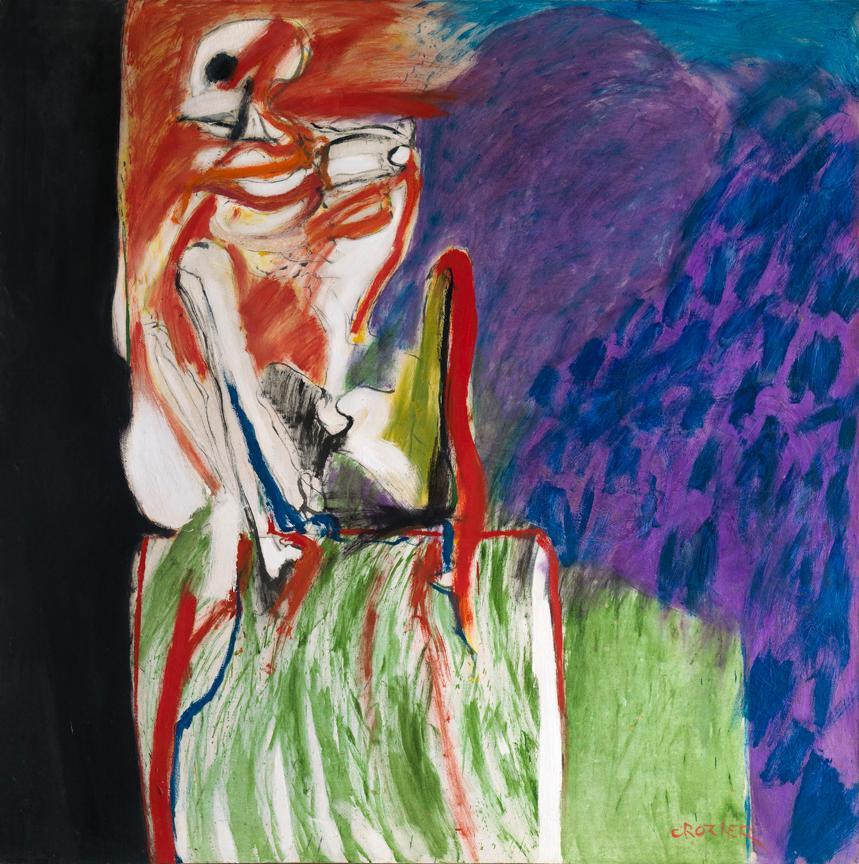
William Crozier
, Irish, 1930-2011
Title
Flanders FieldsDate1962
MediumMixed media on canvas
Dimensions
152 x 151.8 cm
Signedlower right: CROZIER
Credit LinePurchased, 2012
Object numberNGI.2012.24
DescriptionGlasgow-born William Crozier is best known in Ireland for the Irish-inspired work he produced from the 1970s onwards. He was, however, a prominent figure in the London art world in the late 1950s and 1960s, and was closely associated at various points with prime movers in British and Irish cultural life. 'Flanders Fields' coincides with a particularly significant period in Crozier’s career. He had begun to look at American gestural painting, but his work at this time compares more usefully with that of such European painters as Dubuffet, Soulages and de Stael. He visited Ireland for the first time in the summer of 1962, undertaking a walking tour that included Cork, Kerry, Galway and Dublin, which affected him deeply. He became an Irish citizen in 1973, and from the early 1980s divided his time between Hampshire and Kilcoe in West Cork. The title of this work is evocative rather than literal. The painting succeeds a series of paintings inspired by the landscape of Essex (where Crozier had spent the harsh winter of 1958-59), which he found reminiscent of photographs of the battlefields of France and Flanders during the First World War. In 1961 he started to introduce the human figure, or spectral approximations of it, into his landscapes. Exhibition HistoryNew Perspectives. Acquisitions 2011 - 2020, National Gallery of Ireland, Dublin, 11 May - 2 August 2021
Label TextBy 1960 Crozier was moving away from an earth-coloured palette towards one that was more heightened and chromatic. Soon after, he began to introduce the human figure into his landscapes. Some of these works allude to existential or nihilistic themes, while others of 1961-62, including Flanders Fields, have their origins specifically in the imagery of the First World War, a conflict with which the artist was obsessed at the time.