
Jack B. Yeats
, Irish, 1871-1957
Title
Patriotic AirsDate1923
MediumOil on canvas
Dimensions
35.5 x 46 cm
Signedlower left: JACK B YEATS
Credit LinePurchased, 2011 (Dargan Fund)
Object numberNGI.2011.13
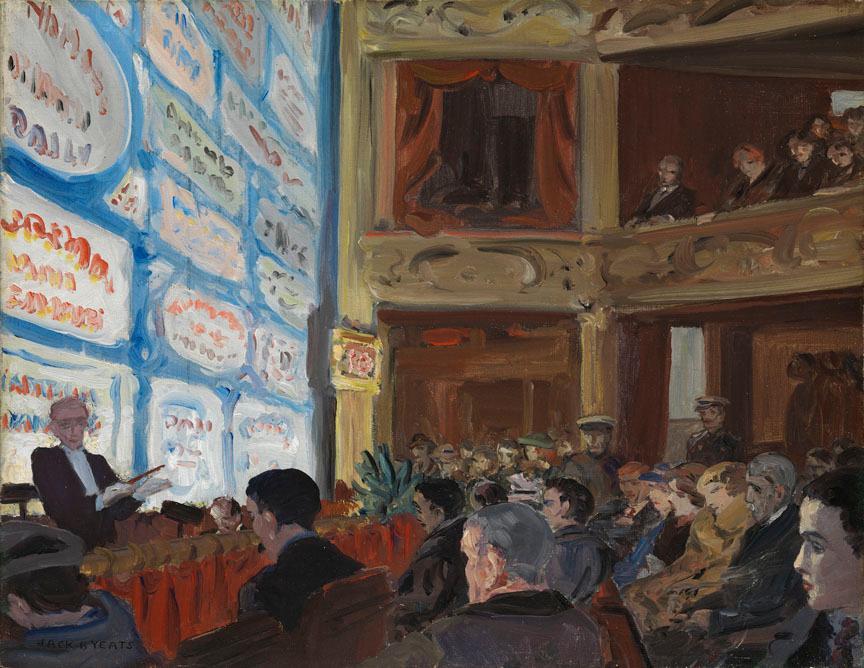
DescriptionA conductor, silhouetted against a summarily described safety screen with advertisements, turns from his orchestra in the Gaiety Theatre, Dublin, to lead the audience in a medley of patriotic songs, a customary activity during the interval in a performance. This work, painted from memory, owes an obvious debt to Yeats’s earlier graphic work, but also to his habitual recording of everyday motifs. In the early decades of his career, Yeats was a skilled and perceptive chronicler of daily life in urban and rural Ireland. This work evinces his skill in depicting crowds and social events, but also reflects his particular interest in the theatre. He took his own literary and theatrical endeavours seriously and spent much of the 1930s writing. Curiously, he did not paint an equivalent scene at the Abbey Theatre, an establishment more closely identified with political and cultural radicalism, and with Yeats’s brother William. 'Patriotic Airs' is contemporaneous with Yeats’s beloved 'The Liffey Swim', but records a markedly different aspect of Dublin social life. While 'The Liffey Swim' conveys the excitement and tumult associated with an open-air, athletic competition, this picture records informal but politically charged activity. In terms of technique, it is a transitional painting that recalls Yeats’s documentary work while anticipating his later, more vigorously executed and abstracted style.
Exhibition HistoryThe Music has Come, The Model, Sligo, 31 May - 28 September 2014
Label TextThe theatre inspired several paintings by Yeats in the 1920s. The setting for this picture appears to be a conflation of the Gaiety, the Empire and Theatre Royal in Dublin, where variety shows were popular. The ‘popular patriotic’ theatre enjoyed its heyday in the final decade of the nineteenth century, but continued into the twentieth. During performances, it was common for the conductor to face the auditorium to lead the audience in a sing-song. Such engagement represented a meaningful and well-established form of political expression that only died out gradually after independence.