
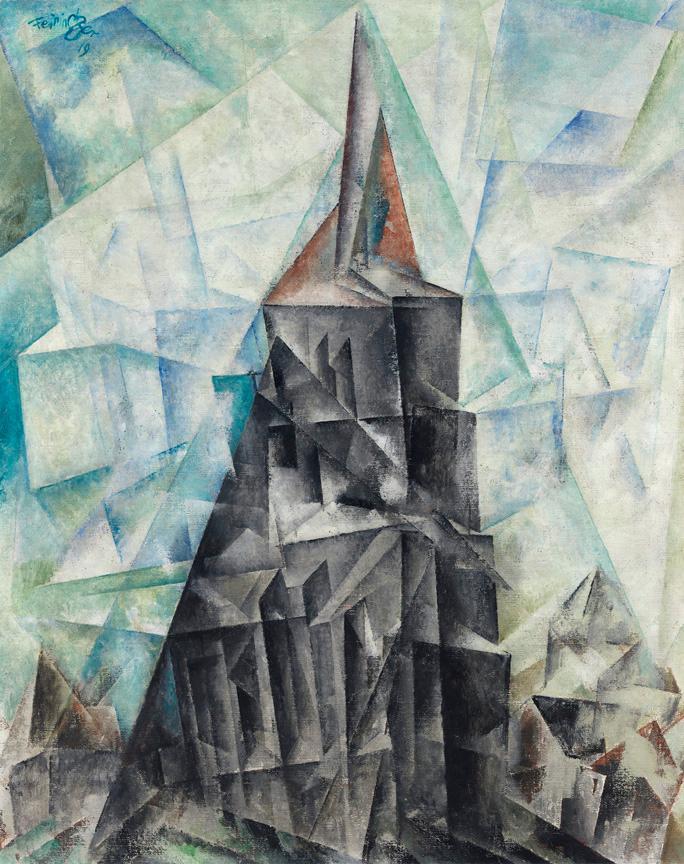
Lyonel Feininger
, American, 1871-1956
Title
Umpferstedt IIIDate1919
MediumOil on canvas
Dimensions
101 × 80 cm
Signedupper left: Feininger [19]19
Credit LinePurchased, 2008
Object numberNGI.2008.91
DescriptionLyonel Feininger was an American painter, illustrator and printmaker. He studied in Hamburg, Berlin and Paris and spent several decades working in Germany before returning to the United States in 1937. Like many of his associates, Feininger’s work was deemed ‘degenerate’ by the Nazis and his pictures were removed from public collections. This is one of three paintings he made which were inspired by the picturesque village of Umpferstedt in the Weimar region. A keen cyclist, Feininger would often make sketches of buildings and streets on his excursions and use them as the compositional basis for prints and paintings. In this picture the facetted forms and restrained dynamism reveal the artist’s interest in Cubism, and particularly in the Orphic work of artists such as Robert Delaunay, which he had seen in Paris in 1911. By using a low viewpoint and grey palette, Feininger presents this rural village with the monumentality of a mountain. It is a modern vision imbued with Romanticism. In 1919 Walter Gropius invited Feininger to become head of the graphic workshop of the newly founded Bauhaus. Feininger’s woodcut print Cathedral of Socialism (1919), designed as the first cover of the Bauhaus manifesto, is very similar in composition to this post-war depiction of Umpferstedt.
March 2016
ProvenancePurchased by Dr Lothar Wallerstein, 1941; by descent; Estate of Maria Wallerstein; purchased, Sotheby's, New York, 7 May 2008, Impressionist and Modern Art, Evening Sale, lot 15 Exhibition HistoryShades of Grey: Painting without Colour, National Gallery of Ireland, Dublin, 22 June - 29 September 2013
Reclaiming Heaven: Art and Religion in Europe, 1918 -1939, Museum Catharijneconvent, Utrecht, 20 February - 15 June 2025
Label TextFeininger worked in Germany for several decades before returning to the United States in 1937. This painting is one of three that he made depicting the village of Umpferstedt in the Weimar region. Its facetted forms and restrained dynamism reveal the artist’s interest in Orphic Cubism. Feininger became head of the graphic workshop of the Bauhaus in 1919. His woodcut print Cathedral of Socialism (1919), designed as the first cover of the Bauhaus manifesto, is similar in composition to this post-war depiction of Umpferstedt.