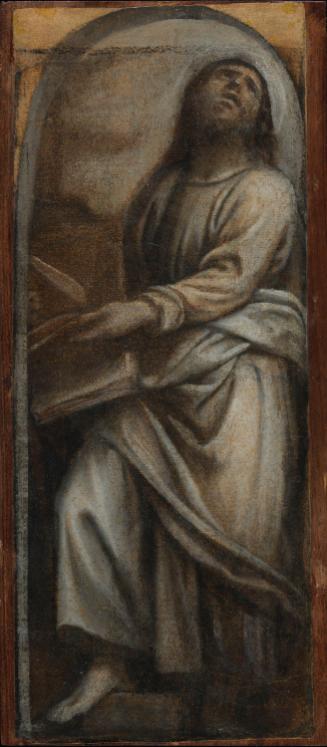
Enea Salmeggia
, Italian, c.1565/70-1626
Title
Saint BartholomewDatec.1605
MediumOil on canvas
Dimensions
173 x 76 cm
Credit LinePurchased, 1863
Object numberNGI.80
DescriptionSalmeggia depicts the martyred Saint Bartholomew gazing to heaven with a pained expression while holding knife – the instrument with which, according to legend, he was flayed alive. In both this work and its pendant, Saint John the Evangelist (NGI.78), Salmeggia has posed the figures elegantly within an architectural framework. The compositions perhaps owes a debt to Sebastiano del Piombo (c.1485-1547), who painted the saint under an arch on the organ shutters of San Bartolomeo, Venice (now Gallerie dell’Accademia, Venice) almost a century previous, and was once thought to be the author of Salmeggia’s completed work.Salmeggia received his main training with Camillo Procaccini in Milan, where he went on to paint a number of altarpieces. He was initially strongly influenced by Raphael and his pupil, Giulio Romano, and always striving for clarity of composition following the dictates of the Counter-Reformation. He reveals here the influence of Lorenzo Lotto’s more expressive interpretation of holy figures, and the soft shadows found in Leonardo da Vinci’s Milanese pupil, Bernardino Luini.
ProvenancePossibly Tynan Abbey, Armagh; purchased, Christie's, Durham, Archdeacon Thorpe sale, 1863Label TextAccording to legend, the apostle Saint Bartholomew was flayed alive. Salmeggia depicted the saint with his attribute: the knife that was used by the perpetrators of his martyrdom. This painting was once a wing of a triptych altarpiece. The artist, who was nicknamed Il Talpino, was a north Italian painter influenced by the work of Raphael. He was interested in art theory and wrote a book about the human form. Parts of this book survive in Francesco Tassi’s compendium of Bergamese artists’ biographies (1793).
Study for/See Also