
Andrea di Bartolo
, Italian, fl. c.1389, d.1428
Title
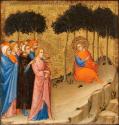
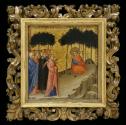
Saint Galgano Inviting the People to Adore the CrossDatec.1415
MediumTempera and gold leaf on wood panel
Dimensions
40.5 x 38 cm
Credit LinePurchased, 1942
Object numberNGI.1089
DescriptionAccording to history, Galganus was a noble knight who, having led a dissipated youth, decided to retreat in 1180 to the solitude of Mount Siepi, near Siena. There, he took the vows of the Cistercian Order and devoted himself to preaching to the people of the surrounding countryside. Although he died only a year later, other believers soon followed his example, and in 1185 created a monastic community that was responsible for building an abbey on the burial place of their founder. Today this is considered one of Italy's most important monuments of French Gothic influence.The episode shown here is a miraculous event which occurred when Galganus, having driven his sword into a rock, started to adore it as a symbol of the Cross, inviting those present to follow him. The original use of the picture is unclear, but one opinion is that it once formed part of a large polyptych, together with a group of panels that are today held in the Museum of San Matteo in Pisa.
Andrea di Bartolo was the son of the painter Bartolo di Fredi, and most certainly was trained by him. His father's influence is evident in the dramatic chiselled ground of the landscape seen here. Later he was for some time inspired by Taddeo di Bartolo, from whom he probably acquired the use of large figures in his compositions.
(National Gallery of Ireland: Essential Guide, 2008)
ProvenanceJameson, Co. Waterford; purchased Mrs. Thomas Jameson, 1942 Exhibition HistoryCentenary Exhibition, National Gallery of Ireland, Dublin, October - December 1964
Label TextGalgano Guidotti was an Italian saint who lived near Siena in the twelfth century. According to legend, the Archangel Michael appeared to Galgano and told him to renounce material things. Galgano, then an arrogant man, replied that to do so would be as impossible as splitting a rock with his sword. He demonstrated by plunging his sword into a rock which miraculously yielded like butter. Awestruck, Galagano devoted himself to a religious life. The sword hilt and grip that projected from the rock resembled a cross, and pilgrims still travel to the chapel at Montesiepi, near Siena, to see it.